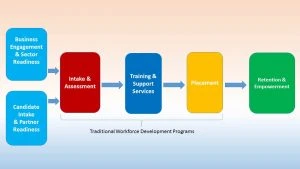
Traditional approaches to workforce development include candidate assessment, training, and placement. The CAW Framework adds employer engagement, sector readiness mapping, and candidate intake partner readiness assessments on the front end, as well as an integrated approach to post-hire support and retention on the back end. This collective impact approach improves the return on investment for employers and the community in a way that was not possible prior to the development of the CAW Framework.
Keep reading to understand more about how the Communities At Work Framework actually works as you begin to consider how the CAW Framework aligns with the mission of your company or organization.
BUSINESS READINESS
Communities At Work uses a pre-defined to help businesses prepare to leverage the CAW Framework to meet their strategic staffing objectives. The CAW Business Readiness Plan includes helping businesses develop a clear business case (including a compelling business need and a clear view of the external environment), gain employee support, assign committed mentors, and define the incremental opportunity to meet their customers’ needs.
CANDIDATE READINESS
As described later, the Communities At Work candidate assessment process is carried out by CAW’s network of community partners, who are asked to classify candidates into one of three categories, based on an employer’s strategic staffing objectives.
- Ready Now candidates are job-seekers facing barriers to employment who are fairly self-directed and motivated to access employment resources.
- Near-Ready candidates are job-seekers facing barriers to employment who may require intensive support and training to prepare and transition them to competitive, sustainable employment. They likely will benefit from follow-along services and coaching in order to retain their employment.
- Ready Later candidates are job-seekers facing significant barriers who need to achieve stability prior to engaging in workforce services. For example, when individuals experiencing homelessness or addiction engage in specialized services first, they are more likely to be successful when they engage in workforce services later.
READY-WILLING-ABLE ASSESSMENT FRAMEWORK
Communities At Work community partners complete their candidate classification using a series of assessments that comprise CAW’s Ready-Willing-Able Assessment Framework.
- In the Ready component of the Assessment Framework, community partners determine the readiness of candidates for work by assessing social stability factors (e.g., whether they have or can be assigned a coach or mentor, whether they have transportation and a phone, whether they have an adequate level of skill with their personal finances, and whether they have addressed key issues related to their own health and wellness and child or senior care).
- In the Willing component of the framework, community partners determine the ability of candidates to be motivated and capable of functioning well in the workplace by assessing items such as a candidate’s personality, interpersonal skills, self-management, self-efficacy, emotional intelligence, resilience, commitment, perseverance, and grit.
- In the Able component of the framework, community partners determine whether candidates have the knowledge, technical skills, and other attributes required to perform specific jobs and assess the potential fit between each candidate and a specific position, company, and culture.
PARTNER READINESS
A network of community partners helps businesses execute the CAW Framework. The CAW Partner Readiness Plan prepares community partners to identify Ready Now and Near-Ready candidates through assessments, support Near-Ready candidates as they move forward into the intake process, and refer candidates in crisis to appropriate service providers as needed.
THE INTAKE PROCESS
During the Communities At Work Intake Process, CAW educates employers on specific talent demand issues, consults with employers to clarify their plans, demonstrates to employers the value of CAW’s approach to talent acquisition, and guides candidates to matching sectors. To make the CAW Intake Process successful, committed organizations and individuals all have a part to play.
- Employers solidify their business case and collaborate on their social and resource commitment.
- Community partner organizations support the intake process as needed by leveraging their specific knowledge and strengths.
- Candidates must be ready and open to the process.
THE TRANSITION PROCESS
During the Communities At Work Transition Process, CAW helps employers develop specific action plans, builds an adequate pipeline of candidates, identifies skill gaps for specific candidates, and consults with employers on best candidate fit. To make the CAW Transition Process successful, organizations and individuals must do their part.
- Employers engage mentors to actively participate in the process.
- Community partner organizations work to remove barriers to candidates’ success.
- Governmental organizations can provide capacity funding.
- Candidates consistently engage in skills training and hands-on skill practice, build connections with community partners and assigned mentors, and gain required credentials.
THE PLACEMENT PROCESS
During the Communities At Work Placement Process, CAW supports a continuous learning environment and helps employers, candidates, and community partners align around shared purpose. To make the CAW Placement Process successful, organizations and individuals have a role to play.
- Employers establish trust with candidates, work to remove candidates’ barriers to success, build candidate teams, and maintain the active engagement of mentors.
- Community partner organizations engage a single point of contact for multiple candidates.
- Candidates maintain open communication, demonstrate their willingness to work, maintain a high level of accountability to the process.
THE RETENTION AND EMPOWERMENT PROCESS
As shown in the table below from FSG, CAW’s process for retention and empowerment relies on four key tenets:
- Providing purpose in the workplace
- Creating opportunities for learning and growth
- Investing in people-centered management
- Making benefits relevant

To make the CAW Retention and Empowerment Process successful, here’s what organizations and individuals can do.
- Employers build purpose and growth opportunity into the workplace, help employees achieve enhanced productivity and gain a strategic view, and work to build long-term talent.
- Community partner organizations build stronger connections to the community ecosystem and apply lessons learned to new candidates.
- Candidates bond with their new teams, understand their purpose, work toward the mastery of skills, and mentor new candidates.
WHO BENEFITS?
Click here to learn more about how the CAW Framework is designed to meet the needs of a wide variety of stakeholders.